
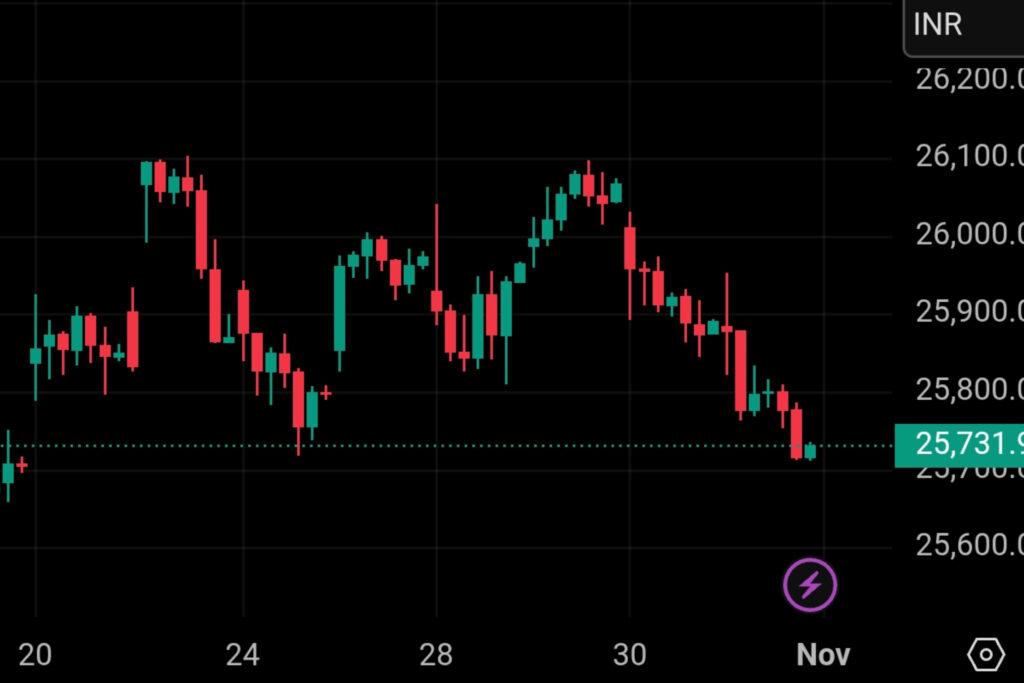
Indian stock market crashed 350+ pts
The Indian stock market closed lower on Thursday, ending the month of October on a weak note as heavy selling in media and metal stocks dragged major indices down. While the broader mood remained cautious due to global uncertainty and profit-booking, PSU banks offered a bright spot, showing resilience amid the volatility.
The BSE Sensex dropped 465.75 points or 0.55%, closing at 83,938.71, while the Nifty 50 slipped 155.75 points or 0.60%, ending at 25,722.10. Market experts said the fall was largely driven by weak global cues and profit-taking after a strong October rally.
Broader indices also showed pressure — the BSE Midcap index fell 0.5%, and the Smallcap index was down 0.4%, signaling mild weakness across the Indian stock market spectrum.
Sector-Wise Market Performance
In Thursday’s session, the Nifty Media and Nifty Metal indices were the top losers, declining nearly 2% each. Weak global commodity prices and subdued investor confidence weighed heavily on these sectors. The power and auto sectors also ended in the red as higher input costs and profit-booking hit sentiment.
Meanwhile, PSU bank stocks continued their winning streak. The Nifty PSU Bank Index rose about 1.5%, supported by strong quarterly earnings and improved asset quality across state-run banks. This helped limit broader losses in the share market today.
On the other hand, IT, private banking, and pharma stocks slipped by 0.4–0.6%, as foreign investors turned cautious and global demand indicators remained uncertain.
Top Gainers and Losers in the Stock Market
Among the top gainers, Bharat Electronics (BEL) jumped 3.95% after robust order inflows and a positive management outlook. Eicher Motors, Shriram Finance, L&T, and TCS also gained marginally during the day.
In contrast, Eternal Ltd was the worst performer, losing 3.52%, while Cipla, NTPC, and InterGlobe Aviation (IndiGo) faced heavy profit-booking.
Company-specific highlights included:
Macrotech Developers (Lodha) gained 2% after posting strong Q2 earnings with solid profit growth.
Bandhan Bank shares crashed nearly 8% after its Q2 net profit plunged 88%, raising concerns over asset quality.
TD Power Systems soared 10% after reporting a 45% YoY jump in profit, supported by strong export demand.
Weekly and Monthly Stock Market Trends
On a weekly basis, both benchmark indices ended lower, the Sensex slipped 0.3%, and the Nifty 50 lost 0.6%. However, for the month of October 2025, the Indian stock market delivered solid gains, with both indices rising nearly 4.5%, marking the best monthly performance of the year.
The surge was driven by strong earnings, increased domestic participation, and a record-breaking IPO season that raised over ₹46,000 crore across 14 public offerings.
Market Analysis and Global Cues
Market analysts noted that Thursday’s correction was largely profit-booking driven, following weeks of steady gains.
Rising U.S. bond yields above 4.8%, higher crude oil prices near $88 per barrel, and weak global market sentiment added pressure.
Foreign Institutional Investors (FIIs) continued to be net sellers, offloading stocks worth over ₹1,400 crore, while Domestic Institutional Investors (DIIs) remained net buyers, reflecting strong domestic confidence in the Indian stock market outlook.
The India VIX, a measure of market volatility, rose nearly 2%, indicating cautious investor sentiment ahead of global economic data releases.
Expert Opinions and Investor Takeaways
Dr. Meera Ghosh, Chief Market Strategist at Insight Invest, commented, The Indian stock market had a strong October and this correction is a natural cooling-off phase. It’s a healthy consolidation rather than a sign of reversal. Investors should stay patient and use this opportunity to accumulate quality large-cap stocks.
Rajiv Sen, Senior Financial Analyst at Axis Wealth, added, The strength in PSU banks is encouraging. With improving credit growth and government support, they remain well-positioned for the coming quarters. Investors should focus on value-driven sectors like banking, manufacturing, and infrastructure instead of chasing high-valuation IT or FMCG stocks.
Experts also highlighted that India’s long-term story remains robust, backed by 7%+ GDP growth, stable inflation, and rising corporate profits.
For investors:
While short-term volatility may continue, analysts believe the Indian stock market remains in a strong structural uptrend. Corrections like these are seen as buying opportunities rather than warning signs.
Traders are advised to monitor support zones near Nifty 25,600–25,650 and resistance at 26,000, while long-term investors should focus on fundamentally sound companies with sustainable growth.
Smart investors buy when markets dip not when they peak.
~Based on moneycontrol.com